EU Wine E-Labels: What the QR Code on Your Bottle Must Contain
EU wine must declare ingredients and nutrition since December 2023. What stays on the bottle, what a QR e-label carries, and how to stop the data drifting.
A pallet sits in a bonded warehouse at a European port, and it is not moving. The importer’s compliance team has scanned the QR code on a sample bottle and reached a page that opens with a newsletter sign-up and a “Buy now” button before it gets to the ingredients — if it gets to them at all. That page breaks the rules, the shipment is held, and a producer who did everything right in the cellar is now losing shelf dates over a web page. This is the quiet way the new EU wine labelling regime bites: not usually at the printing press, but at the destination the QR code points to.
For most of its history a wine label told you a place, a grape, a vintage and an alcohol level. Since December 2023 it has to tell you more — what is in the bottle and what it does to your diet — and it introduced something genuinely new: the option to move part of that information off the paper label and behind a QR code. This article explains what the rules actually require, what has to stay on the physical label, what a QR e-label is allowed to carry, and the one problem that catches producers out long after the print run is done — keeping the data behind the code from drifting away from the wine in the bottle.
What changed in December 2023?
The trigger is Regulation (EU) 2021/2117, which amended the EU’s common market organisation rules for wine. From 8 December 2023, wine placed on the EU market must carry two things it never had to before:
- a full list of ingredients, headed by the word Ingredients, with the grapes listed first and additives and processing aids named by their regulated categories, and
- a full nutrition declaration — energy value plus fat, saturates, carbohydrate, sugars, protein and salt, expressed per 100 ml.
There is a transition built in. The new rules apply to wines produced from the 2024 harvest onward; wine produced before 8 December 2023 stays exempt until those stocks are exhausted. So for a while the shelf holds both worlds at once, which is exactly why getting your own process right — rather than copying an older bottle you happen to have on the desk — matters more than it looks.
It helps to see this as the wine sector finally joining the rest of packaged food. The underlying framework, Regulation (EU) 1169/2011 on food information to consumers, has required ingredient lists and nutrition declarations across the food aisle for years. Wine and other alcoholic drinks above 1.2% ABV had a long-standing exemption. The 2021 reform closed that gap for wine, and rather than force every detail onto a small, curved glass surface it allowed the bulk of the new information to travel electronically. That single design choice — mandatory facts, optional medium — is the whole story of the e-label.
What must stay on the physical label?
The distinction most producers need to get right is which facts are anchored to the glass and which may travel to a screen, because it decides what your print run must show. Two things are not optional and cannot be pushed to a QR code:
- The energy value, marked with the letter E and given in both kilojoules and kilocalories, must be printed on the physical label.
- The allergen declaration — for wine, principally sulphites, along with any egg- or milk-derived fining agents that remain in the finished wine — must be on the physical label, under the word Contains.
The reasoning is practical rather than bureaucratic. Energy and allergy information is the part a shopper may need in the moment, at the shelf, possibly with a dead phone or no signal. Someone avoiding sulphites, or counting calories, has to be able to read that on the glass in their hand — not after finding a network, scanning a code and waiting for a page. Everything else in the new set is reference information that a screen can carry perfectly well.
On-label versus e-label at a glance
| Element | Physical label | E-label (QR) |
|---|---|---|
| Energy value (kJ + kcal), marked E | Required | May also appear |
| Allergen declaration (Contains sulphites, egg/milk fining) | Required | May also appear |
| Full ingredient list, headed Ingredients | Optional | Permitted destination |
| Full nutrition table (fat, saturates, carbohydrate, sugars, protein, salt) | Optional | Permitted destination |
| Marketing, shop links, newsletters | Allowed (elsewhere) | Forbidden |
| Analytics, tracking, user data collection | — | Forbidden |
Read the table as one rule with two halves: the shelf-critical facts are pinned to the glass, and the e-label is a neutral reference sheet — never a marketing surface.
What can move behind the QR code?
Everything else in the new mandatory set — the full ingredient list and the full nutrition declaration — may be provided electronically instead of on paper. This is the off-label option, and the electronic destination is what the trade calls an e-label. In practice a compliant physical label can be quite lean: the energy value, the allergen line, and a QR code. Scan the code and you reach a page carrying the complete ingredient list and the complete nutrition table. Regulation (EU) 2021/2117 permits this, and Commission Delegated Regulation (EU) 2023/1606 sets the conditions the electronic page must meet.
Those conditions are stricter than they first appear, and they are where good intentions quietly go wrong.
The e-label page must be neutral
The page a QR code leads to may show only the regulated information. It must not carry marketing or sales content, and it must not collect or monitor any user data. Both are strict rules with no exceptions. That means no analytics pixel counting scans, no “sign up for our newsletter”, no shop link on the ingredients page, no cookie banner harvesting consent for advertising. If your marketing platform generates QR codes that track opens or funnel visitors to a product page, it is the wrong tool for this job — and, as the port example shows, it is exactly the kind of thing an importer’s audit is looking for.
The information must be as accessible as print
The electronic information has to be at least as visible and accessible to the consumer as it would be on a physical label. A page that demands an app, a login, a language the buyer cannot read, or a slow load fails that test. And the word Ingredients must be easy to identify — a bare i icon on the code is not enough, as the Commission clarified, because a consumer must not confuse the regulated destination with a general marketing link.
One wine, many markets, several languages
There is a further wrinkle the regulation implies rather than spells out: a wine sold across borders needs its mandatory information in a language the buyer in each market understands. A bottle that moves from an EU market into, say, a Romanian retailer and a German one has to present its ingredient and nutrition information in terms those consumers can read. On a paper label that means crowded multilingual panels; behind a QR code it means the e-label can serve the right language without reprinting anything. That flexibility is one of the genuine upsides of the electronic route — provided the language versions all resolve back to the same underlying facts for a given bottling, rather than becoming several drifting documents that happen to share a wine.
The drift problem nobody warns you about
Here is the failure mode that turns a tidy compliance feature into a liability, and it has nothing to do with the print run. A QR code is printed once, at bottling, and then it is out in the world — on pallets, on shelves, in a shop in another country — for years. The page it points to, by contrast, is a live web resource that somebody can edit at any time. Those two timelines are not naturally in sync.
Imagine you tweak a fining regime, correct a typo in the sugar figure, or restructure your e-label site a year after a vintage shipped. If the page behind last year’s QR code changes, the facts a consumer scans no longer describe the wine in that bottle. You have not reprinted anything — the physical code is identical — yet the information it delivers has quietly drifted. For a regulated declaration that gap between the printed token and the live data is a real problem: you can no longer prove what a given bottle declared at the moment it was placed on the market, which is precisely the question an inspector or a retailer’s compliance desk will ask.
Reprinting the physical label does not help either — the whole point of the QR option is that you print once and update rarely. The fix has to live on the data side, in how the destination behind the code is versioned.
How to keep e-label data honest
The durable answer is to treat a published e-label as a frozen snapshot, not a live document. At the moment you publish the label for a given bottling, capture every regulated fact — the ingredient list, the full nutrition values, the allergen and sulphite declaration — into an immutable version. Print the QR code against a stable token that resolves to that version and no other. If you later change a recipe or fix an error, you publish a new snapshot for future bottlings; the bottles already in the market keep pointing at the exact facts that were true when they were sealed. Nothing you edit tomorrow can rewrite what last year’s bottle declares.
That model gives you three things at once:
- Consumers always see facts that match the bottle in their hand.
- Regulators and retailers can be shown precisely what any bottling declared, and when — a provable record, not a “trust us, the page is right today”.
- Your team can improve the label going forward — a clearer wording, a corrected figure, an added language — without endangering anything already shipped.
There is a second, upstream half to honesty that is easy to overlook: the facts on the e-label are only as good as the production data they come from. If the sugar figure, the fining agents, or the sulphite level are retyped by hand into a labelling tool, they can be wrong before they are ever frozen. The strongest position is one where the declared facts are derived from the same records that run the cellar — the traceable chain from grape intake through must and wine to the bottled SKU — so the label restates the truth of production rather than paraphrasing it. That is the connection between labelling and everyday cellar record-keeping, and it is why the two problems are best solved in one system.
A practical rollout for a small winery
You do not need a compliance department to get this right. A workable sequence:
- Inventory your active SKUs and note which were produced from the 2024 harvest onward — those are the ones that must comply now.
- Assemble the regulated facts per wine: ingredient list (grapes first, additives and processing aids by category), the full nutrition values per 100 ml, and the allergen line.
- Redesign the physical label to carry the energy value, the allergen declaration, and a QR code — and nothing else it did not carry before.
- Choose a neutral e-label destination that shows only the regulated information, in the languages your markets need, with no tracking or marketing.
- Freeze a snapshot at publication and bind the printed QR to that version, so a later correction mints a new code rather than rewriting a shipped one.
- Keep the evidence: for each bottling, retain what was declared and when, ready for an importer’s audit or a national authority.
The order matters. Producers who start at step 3 — a nicer label, a QR generator from a marketing tool — are the ones whose pallets get held at step 4.
How Wineopsys handles this
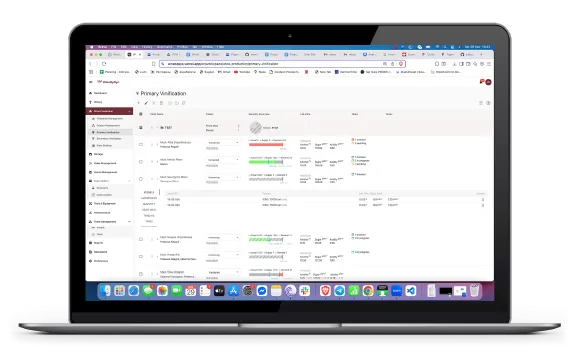
Wineopsys builds the e-label directly on the production record, so the declared facts come from the same lot and bottling data the cellar already maintains rather than from a separately keyed marketing page. Because stock is a ledger-projected figure and the wine carries a traceable identity chain — intake to must to wine to bottled SKU — the ingredient, nutrition and allergen information restates what production actually did. A fail-closed SO₂ gate before bottling means the sulphite reality behind that allergen line is checked, not assumed.
When a label is published, Wineopsys freezes an immutable snapshot of the regulated information — the EU 1169/2011 nutrition declaration, the ingredients, the allergen and sulphite declaration — and binds the printed QR code to a stable token for that snapshot. Because the snapshot is sealed, the facts behind a printed code cannot drift after the bottle leaves the cellar; a later correction becomes a new published version for future bottlings, never a silent rewrite of what is already on the shelf. For producers who also file under Moldova’s HG 292/2017 Anexa registers, the same production records feed both the national paperwork and the EU-facing e-label, and the product itself is trilingual — English, Romanian and Russian — running on Cloudflare’s edge so a scan resolves quickly wherever the buyer is. If you want the wider picture of how those records hang together, our guides to block-to-bottle traceability and to what a winery ERP actually is go deeper, and the ledger-versus-spreadsheet piece explains why derived stock beats a hand-edited number.
Who is on the hook if the e-label is wrong?
Responsibility follows the name on the label. The food business operator under whose name the wine is marketed is accountable for the accuracy and presence of the mandatory information, and where that operator is outside the EU the importer placing the wine on the market carries the obligation. In practice that means two parties have a direct stake in your e-label being correct and stable: you, the producer, and whoever imports the bottle. National authorities in each member state enforce the rules and can require non-compliant product to be corrected or withdrawn — which, for a page behind a QR code, can mean relabelling stock that is already distributed. That is the expensive version of the drift problem, and it is why the provable snapshot is not a nicety. When an importer or an inspector asks “what did this bottling declare, and can you show me,” the winery that can answer with a sealed, dated version has a short conversation, and the one relying on “the page says so today” has a long one.
The bottom line
The EU’s post-2023 rules ask for more information and offer a sensible way to deliver part of it: keep energy and allergens on the glass, and put the full ingredient list and nutrition table behind a neutral, privacy-clean QR code. The requirement most producers underestimate is not what to publish but how to keep it stable and how to prove it. A printed code lives for years; the data behind it must be pinned to the version that was true when the bottle was sealed, and traceable back to the production that made it. Get that right and the QR code stops being the thing that holds a pallet at the port and becomes what it was meant to be — a durable, honest link between a bottle and the truth about what is in it.
We are building Wineopsys as the system that keeps this connection intact end to end, from grape intake to a sealed, snapshot-backed e-label. If that is the kind of compliance you would rather have handled at the source than patched at the port, join the waitlist and we will keep you posted as we open access.
Frequently asked questions
- What must an EU wine label contain since December 2023?
- Since 8 December 2023, wine sold in the EU must declare a full list of ingredients and a full nutrition declaration — energy plus fat, saturates, carbohydrate, sugars, protein and salt. Under Regulation (EU) 2021/2117 the energy value and the allergen declaration must appear on the physical label, while the full ingredient list and full nutrition table may be provided electronically through a QR code — the so-called e-label. The rules apply to wine from the 2024 harvest onward; wine produced before 8 December 2023 is exempt until stocks run out.
- Do wine e-labels need to list ingredients?
- Yes. The full ingredient list is one of the two things a wine e-label is designed to carry — the other being the complete nutrition table. The list is headed by the word 'Ingredients', starts with the grapes, and names additives and processing aids by their regulated categories. Only the allergen declaration and the energy value must stay on the physical label; the rest of the ingredient information may sit behind the QR code, provided that page shows nothing but the regulated facts.
- Can I change a wine e-label after bottling?
- You should never rewrite the page a shipped bottle already points to. If you edit the facts behind an in-market QR code, the information a consumer scans silently diverges from the wine actually in that bottle — a compliance and trust failure. The safe pattern is to freeze the declared facts into an immutable snapshot at publication and print the QR code against that fixed version. A correction becomes a new snapshot for future bottlings, never an edit to what is already on the shelf.
- Can a wine QR code track the consumer or show marketing?
- No. The e-label page must not collect or monitor any user data, and it must not present commercial or promotional content — a strict rule with no exceptions under Commission Delegated Regulation (EU) 2023/1606. The QR code must lead directly to the regulated information, and the word 'Ingredients' must be easy to identify so the destination is not confused with a marketing page. An 'i' icon alone is not an adequate label for the code.
- What is a wine e-label and how does the QR code work?
- A wine e-label is the electronic delivery of the mandatory ingredient list and nutrition declaration through a QR code or link printed on the bottle, instead of on paper. Permitted by Regulation (EU) 2021/2117 and detailed in Commission Delegated Regulation (EU) 2023/1606, the scanned page must show only the regulated information, load at least as easily as a printed label would be read, carry a clear 'Ingredients' heading, collect no data, and contain no sales content.
- Do EU wine labelling rules apply to imported wine?
- Yes. The requirements attach to wine placed on the EU market, not to where it was produced, so a winery exporting into the EU must meet the same ingredient, nutrition, allergen and energy rules as a domestic producer. That is why non-EU exporters — including producers in Moldova, Georgia and beyond — are building compliant e-labels now, and why the declared facts need to trace cleanly back to production records rather than being retyped for each market.