Fermentation Temperature: The Winemaker's Most Underrated Decision
Whites usually ferment at 12–18°C and reds at 20–30°C. Temperature shapes aroma and extraction, decides stuck-fermentation risk, and must be logged twice daily.
Ask a new winemaker what decides the character of a wine and you will hear about the vineyard, the grape, the yeast, the barrel. All true. But the single control that quietly shapes more of the finished wine than almost any other — and the one most likely to be treated casually in a first vintage — is fermentation temperature.
It is not glamorous. It is a number on a tank, taken once or twice a day. Yet that number decides which aromas survive, how much colour and tannin a red gives up, how fast the yeast work, and whether the ferment finishes cleanly or grinds to a halt with sugar still in the tank. This is a practical guide to why temperature matters so much, the ranges most producers work within, what actually goes wrong at the extremes, and why the humble twice-a-day written check is worth far more than it looks.
What temperature should wine ferment at?
The short answer, before the detail: white wine is generally fermented cool, in the 12–18°C range, and red wine warm, in the 20–30°C range. Aromatic whites sit at the lower end, near 12–15°C, to hold their delicate aromatics. Reds meant for deep colour and firm tannin run toward the top of their band, near 26–30°C. Above roughly 32–35°C, any ferment leaves the useful range and enters real risk.
Those two bands are the spine of this guide. Everything else — why they differ, why a tank refuses to stay inside them, and how you keep it there — follows from understanding what temperature is actually doing to the wine.
Why does temperature shape aroma and extraction?
Fermentation is not a single reaction but a whole population of living yeast doing chemistry, and like all chemistry it speeds up as it warms. That simple fact has consequences at both ends of the wine.
For whites, the prize is usually aroma. The fruity and floral notes that make a young white wine sing are volatile esters and thiols — light molecules that are easily driven off by heat and vigorous bubbling. Ferment cool and slow, and more of them stay in the wine. Ferment warm and fast, and you blow them out through the airlock along with the CO₂. This is why aromatic whites are fermented at cellar-cold temperatures: the goal is to preserve something fragile. A Sauvignon Blanc fermented at 13°C keeps a nervy, high-toned character that the same juice fermented at 20°C would trade away for something rounder and flatter.
For reds, the prize is usually extraction. Colour (anthocyanins) and tannin live in the skins, and heat helps pull them into the wine. A warm red ferment extracts more deeply and finishes faster, which is why reds are run warm even at the cost of losing some of the fresh fruit aromatics a cooler ferment would keep. The winemaker is making a deliberate trade: structure and colour over primary fruit. Push the temperature up and you get a darker, more tannic, more concentrated wine; hold it down and you keep more perfume at the expense of grip.
So temperature is not a comfort setting. It is a dial that moves the wine along the axis from aromatic and delicate to extracted and structured, and every producer sets it on purpose. The number you choose is a stylistic signature as much as anything that happens in the vineyard.
What are the typical fermentation temperature ranges?
There is no single correct number — style, grape and intention all move it — but common practice clusters into clear bands. The table below is a working reference, not a rulebook; treat it as the middle of the road you are driving on, with your own house style and grape deciding where in the lane you sit.
| Wine style | Typical range | Why this band |
|---|---|---|
| Aromatic whites (Sauvignon Blanc, Riesling, Muscat) | 12–15°C | Preserve fragile esters and thiols; slow, gentle ferment |
| Other dry whites and rosé | 15–18°C | Balance aroma retention with a reliable finish |
| Lighter, fruit-forward reds | 20–25°C | Moderate extraction, keep some primary fruit |
| Structured reds for colour and tannin | 26–30°C | Drive deep skin extraction and a brisk ferment |
| Danger zone (any style) | above 32–35°C | Yeast heat stress, off-characters, stuck-ferment risk |
A cooler ferment is slower and gentler, and that slowness is often the point — a white held at 13°C might take two or three weeks to finish, and every one of those days is buying you aromatic detail. A warm red, by contrast, can rip through its sugar in under a week, which is efficient but leaves far less margin for error if the temperature starts to run away. The skill is not hitting one perfect figure; it is keeping the ferment inside its intended band from the first day to the last.
Why does a fermenting tank heat itself?
Here is the part that catches people out: fermentation makes its own heat. The conversion of sugar to alcohol is exothermic, so a healthy, active ferment warms up on its own, without any help from the cellar. A vigorous red at peak activity can run several degrees hotter than the room around it. The warmer it gets, the faster the yeast work; the faster they work, the more heat they throw — a self-reinforcing loop that, left unchecked, only points in one direction.
Reds add a second twist. The floating cap of skins that forms on a red ferment traps heat, so the top of the tank can run noticeably hotter than the liquid beneath it. It is entirely possible for the cap to be sitting in the danger zone while a thermometer dropped into the middle of the tank reads a comfortable 27°C. Punching down or pumping over — the cap-management work a red ferment needs two or three times a day — mixes that trapped heat back through the tank and, not coincidentally, is exactly when a lot of temperature checking happens. Cap work and temperature reading are the same trip up the ladder.
The practical upshot is that a ferment left alone does not stay put. Without active cooling — a jacketed tank, a cold room, a plate chiller circulating the must — a strong fermentation can drive itself out of its safe band and into trouble. That is why the temperature is measured, not assumed. The tank will not announce that it is overheating; the thermometer will, and only if someone is holding it.
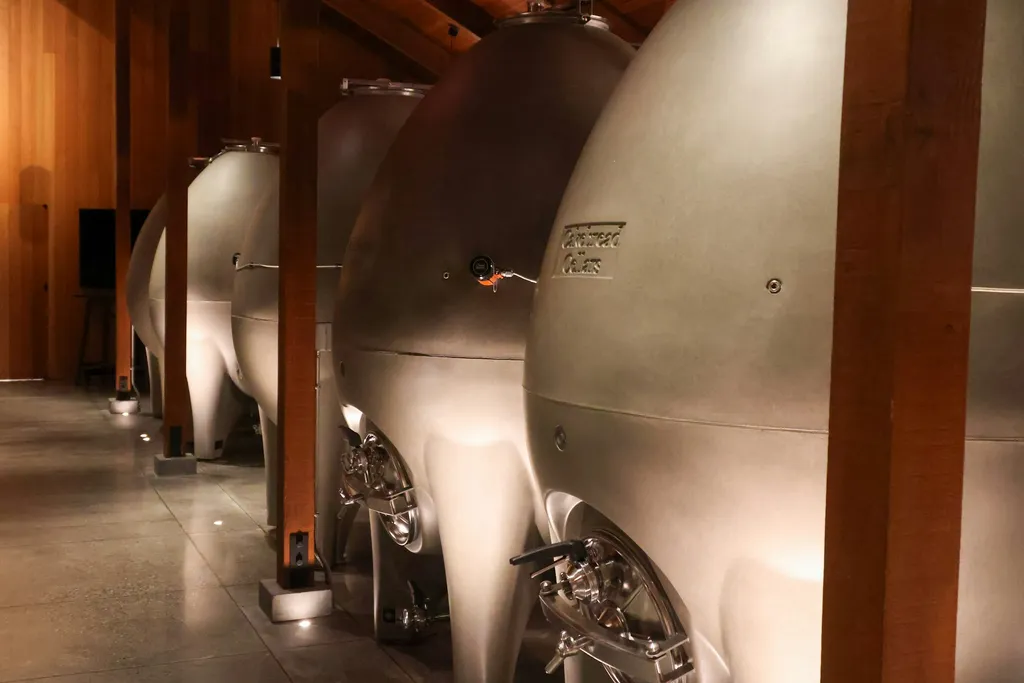
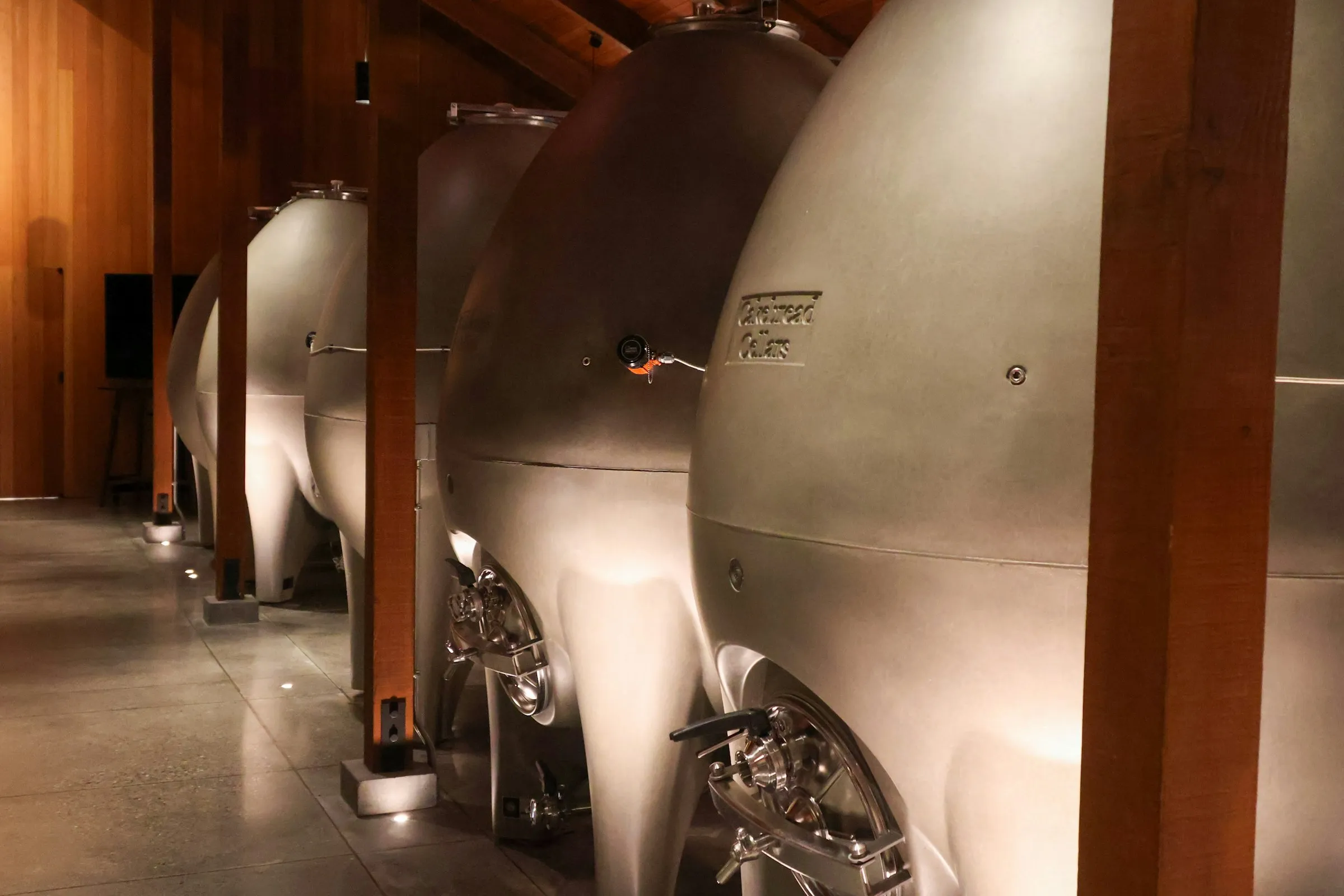
Jacketed stainless tanks let a winery hold a ferment inside its intended band — but only if someone is reading and logging the temperature. The cooling is only as good as the measurement that tells you to switch it on.
A red fermenter spiking during a heatwave
Picture a small cellar in the middle of harvest. Three red fermenters are at peak activity, the outside temperature has climbed to 34°C for the third day running, and the cellar — never designed for a heatwave — is holding at 24°C instead of its usual 18°C. Tank two, a Cabernet on skins, read 28°C at the morning cap-down. By mid-afternoon nobody has been back to it, because the whole crew is on the crush pad receiving fruit.
That tank is now the most dangerous object in the building. The ferment is exothermic, the ambient heat is working with it instead of against it, and the cap is trapping the worst of it up top. If the next reading does not happen until the evening cap-down, the winemaker may walk up to a tank at 35°C with a cap running hotter still — yeast already stressed, alcohol already high, and the two combining to knock the fermentation population back at exactly the moment it needs to be strong. Cooling now is a rescue operation: drop the jacket, pump over cold, hope the yeast recover.
The version of this story that ends well is not the one with a better tank. It is the one where somebody read tank two at midday, saw it had climbed three degrees since morning, and turned the cooling on then — while the fix was still cheap. The difference between the two endings is a single logged reading, taken on schedule, during the busiest afternoon of the year. That is the whole argument for a monitoring discipline you can trust when the cellar is at its worst.
A cold cellar stalling a white
The opposite failure is quieter and, for that reason, easier to miss. An aromatic white is fermenting at 13°C in an underground cellar, exactly where the winemaker wants it. Then a cold snap drops the cellar a few degrees over a weekend. Nobody is worried — cool is good for whites — so the tank goes unchecked from Friday evening to Monday morning.
By Monday the ferment has slowed to a crawl. At 9°C the yeast have begun to flocculate and settle out of suspension, and the sugar has stopped falling. This is a stall in slow motion: there is no dramatic heat, no smell of trouble, just a density reading that has barely moved in three days. Restarting a cold-stalled ferment is genuinely hard — you may need to warm the tank gently, rouse the lees, and sometimes pitch a fresh, restart-tolerant yeast culture — and the whole time the wine is sitting with residual sugar and dropping protection, which is a microbial risk of its own.
Again, the tank did nothing surprising. Cool white ferments are known to be exposed to exactly this if the temperature drifts down too far. What failed was the watching. A density-and-temperature reading on Saturday would have shown the sugar curve flattening and the temperature below its intended floor, and a nudge of gentle warmth over the weekend would have kept the ferment alive. The stall was not caused by the cold snap; it was caused by nobody looking during it.
What goes wrong at the extremes?
Push too far in either direction and the ferment can stick — stop before the yeast have finished converting the sugar. It is one of the most stressful things that can happen in a cellar, because a tank with residual sugar and dropping yeast activity is both a quality problem and a microbial risk. Spoilage organisms are happy to finish what the yeast would not.
Temperature sits at both ends of the cause:
- Too cold, and the yeast slow down, then flocculate and settle out of suspension. The fermentation quietly stops, sometimes with a lot of sugar left. Cool white ferments are especially exposed to this if the tank drifts down too far, as the cold-cellar scenario above shows.
- Too hot, and the yeast are stressed and begin to die off — an effect made much worse when alcohol is already high, because heat and ethanol together are particularly hard on yeast. A red that spikes above the mid-30s can lose its fermentation population at exactly the wrong moment, with a third or more of the sugar still unconverted.
Other factors pile on — nutrient shortage, very high starting sugar, low pH — but temperature is the lever the winemaker holds most directly, and it is the one that gives the earliest warning. A ferment does not usually stick without notice. It slows, its temperature curve flattens, its sugar stops falling. Whether you catch those signals depends entirely on whether you are recording them.
How does yeast strain tolerance change the maths?
Not all yeast tolerate the same conditions, and the strain you pitch quietly widens or narrows the band you have to defend. Some commercial strains are selected for cool-fermentation performance and hold up well down toward 12°C; others are bred to keep working at the warm end of a red ferment and to shrug off higher alcohol. Choosing a strain matched to your intended temperature is part of setting the band in the first place.
But tolerance is not permission to stop watching — it is a bit more margin, not a different game. A strain rated for warm reds still suffers past the mid-30s. A cool-tolerant white strain still flocculates if the tank falls far enough. And the strain’s tolerance interacts with everything else: a yeast that handles 30°C in clean juice may fail at the same temperature once alcohol is high and nutrients are short. The datasheet gives you a starting envelope; the tank tells you what is actually happening inside it. Knowing your strain’s tolerance sharpens your thresholds — it never removes the need to measure against them.
How often should fermentation be checked?
Every point above comes back to one habit: measuring temperature and density on a schedule and writing them down. The working standard is at least twice a day during active fermentation — morning and evening — and more often for a vigorous red at peak, or any tank during a heatwave. Crucially, temperature and density are read together, because neither one alone tells the full story.
A single reading tells you where a tank is right now. A series of readings tells you where it is going — and that trajectory is what actually lets you intervene in time. A ferment climbing a degree every few hours toward the mid-30s, or a cool white sliding below its safe floor, is a problem you can still fix cheaply if you see the trend. The same problem discovered as a fait accompli is a stuck tank and a salvage operation.
Reading density alongside temperature is what turns two numbers into a diagnosis. Temperature rising while density falls steadily is a healthy, vigorous ferment doing exactly what it should. Temperature high while density has stopped falling is a tank in trouble — the heat is there but the sugar conversion has stalled. Density falling with the temperature drifting toward the floor is a cool ferment at risk of going to sleep. The two curves read together are an early-warning system; either one alone is half a picture. This is why the classic cellar habit is a paired log — temperature and specific gravity, per tank, twice a day — from pitch to dryness.
Why do written temperature checks matter?
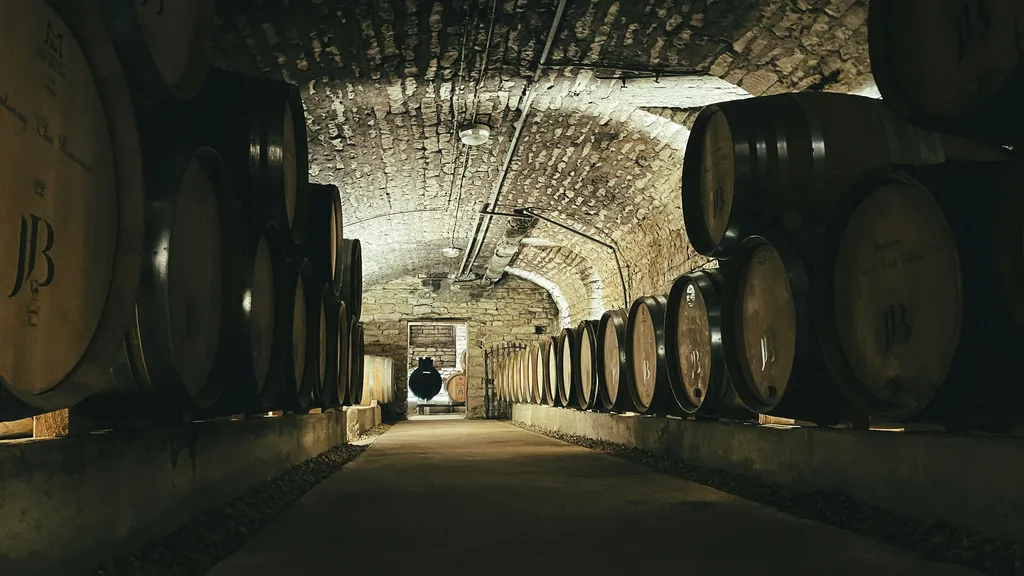
During harvest, when several ferments run at once and the cellar is at its busiest, memory is not a record. A dated log per vessel — temperature and density, taken at a consistent cadence — turns a wall of active tanks into something you can actually read. It shows which ferments are healthy, which are lagging, and which are heading for the danger zone while there is still time to cool, warm, or feed them. It is the difference between managing a cellar and reacting to one.
This is where good record-keeping stops being paperwork and becomes winemaking, and it is precisely the discipline that a purpose-built cellar system is meant to protect. In Wineopsys, a fermentation check is a real, timestamped record against a specific vessel — temperature and density captured as the ferment is worked — so the curve is visible per tank rather than living in someone’s head. Plot enough of those points and the trajectory speaks for itself: the tank that is about to stall shows you a flattening line before it shows you a problem.
Because the same busy afternoons that most need checks are the ones where checks get skipped, the recording has to survive real cellar conditions. When you work a round across many vessels at once — a cap-management or temperature sweep over forty barrels or a bank of tanks — Wineopsys keeps per-vessel evidence for each one, and a skipped vessel is recorded as a fact, not a silent gap. A blank in the log is ambiguous; “checked, and here is the reading” versus “deliberately skipped, and here is why” is not. And a fermentation check passes the same validation whether it is typed at a desk or on a phone in a cold cellar corner — a submission either lands on the curve or tells you it didn’t, never a silent drop.
From there the readings stop being a passive log and start working for you. A fermentation watch on the dashboard can surface the tanks trending toward their limits, so the morning after a heatwave begins with a list of what to check first rather than a walk of the whole cellar. A worrying reading can be raised in the team messenger with the vessel referenced directly, so the person on the crush pad and the person at the tank are looking at the same tank. And the AI copilot can summarise where each ferment stands — while never writing to the record on its own: its actions always require operator approval, so a human confirms anything that changes the log. The value is never the tidy record itself; it is seeing the stall coming while you can still do something about it.
The bottom line
Fermentation temperature rarely gets the credit it deserves because it is invisible in the glass — you taste the aroma it preserved or the structure it extracted, not the number that produced them. But that number is one of the most consequential decisions a winemaker makes, and one of the easiest to lose control of, because a healthy ferment generates its own heat and will happily cook itself if left alone. Set the band on purpose, choose a yeast strain that matches it, cool or warm to hold it, and — above all — measure temperature and density together, twice a day, and write them down. The tank that sticks is almost always the one nobody was watching closely enough, and the record that would have warned you is the one that was never kept.
If you are thinking about how to run your next vintage, turning your fermentation checks into a real per-vessel early-warning system is one of the highest-leverage places to start. Wineopsys is being built for exactly that kind of cellar record, and you can join the waitlist to follow along as it opens up.
Frequently asked questions
- What temperature should white wine ferment at?
- Most producers ferment white wine cool, commonly between 12 and 18°C, and aromatic styles such as Sauvignon Blanc or Riesling often sit at the lower end, near 12–15°C, to preserve delicate fruit and floral esters. Cooler fermentation is slower and gentler, holding onto volatile aromatics that a warm ferment would blow off. The trade-off is time and a higher risk of the yeast stalling if the tank drops too far, so cool white fermentations still need active temperature control rather than simply being left in a cold room.
- What temperature should red wine ferment at?
- Reds are fermented warmer than whites, commonly in the 20–30°C range, and often toward the upper end near 26–30°C when the goal is maximum colour and tannin extraction from the skins. The warmth helps pull anthocyanins and tannins out of the cap and drives a faster, more vigorous fermentation. The winemaker's job is to keep the peak below roughly 32–35°C, because past that point yeast come under heat stress and both fermentation health and aroma suffer.
- How often should fermentation be checked?
- During active fermentation, temperature and density should be checked at least twice a day, morning and evening, and more often for a vigorous red at peak activity or during a heatwave. Checking twice daily catches a rising temperature curve or a stalling sugar drop while there is still time to cool, warm, or feed the tank. A single reading tells you where a ferment is; a series of readings, logged per vessel, tells you where it is heading.
- Why does fermentation get so hot?
- Fermentation is exothermic: as yeast convert sugar into alcohol they release heat, and a vigorous red ferment on skins can climb several degrees above the cellar's ambient temperature on its own. A red cap of floating skins also traps heat, so the top of the tank can run hotter than the liquid below. Without cooling — a jacket, a cold room, or a heat exchanger — a healthy ferment can drive itself into the danger zone, which is exactly why temperature is monitored rather than assumed.
- What causes a stuck fermentation?
- A stuck fermentation is one that stops before the sugar is used up. Temperature sits at both extremes of the cause: too cold and the yeast flocculate and drop out of suspension; too hot, especially combined with rising alcohol, and the yeast are stressed to the point of dying off. Other factors — nutrient deficiency, very high sugar, low pH — compound it, but temperature is the lever the winemaker controls most directly, and a written temperature record is what makes a developing stall visible before it becomes a stuck tank.