What Oak Actually Does to Wine: A Practical Barrel-Aging Guide
How barrel aging works: French vs American oak, new vs neutral, toast levels, barrel formats, the angels' share, hygiene, cost and per-barrel record-keeping.
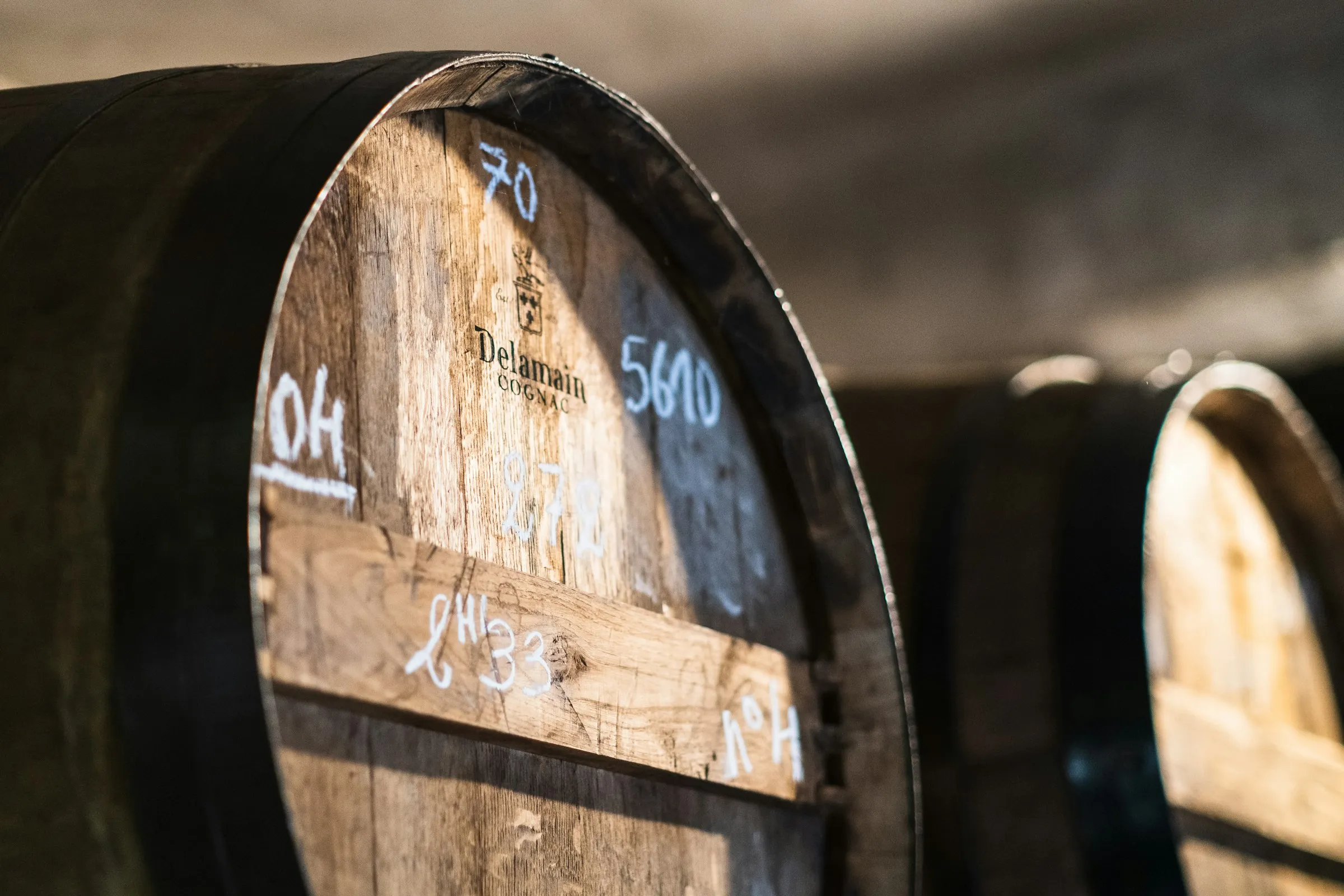
There is a romance to a barrel cellar — the rows of oak, the cool dark, the faint smell of wine and wood — that can make barrel aging feel like something mystical. It is not. Oak does specific, understandable things to wine, for specific reasons, and a winemaker who understands them uses barrels as a precise tool rather than a tradition to be followed blindly.
This is a practical guide to what oak actually contributes: the slow oxygen, the flavour compounds, the differences between French and American wood and between new and old barrels, the toast the cooper burns into the staves, the formats on the cellar floor, the economics of running a barrel program, and the unglamorous but essential work of topping up, keeping the wood clean, and keeping track. Because a barrel program only produces consistent wine if you know what is in every barrel — and that is a record-keeping problem as much as a winemaking one.
How does oak change wine?
Two things happen inside a barrel at the same time, and it helps to keep them apart.
The first is micro-oxygenation. Oak is porous, so a tiny, continuous amount of oxygen seeps through the staves and reaches the wine. This is nothing like the harsh oxidation of a wine left open to air; it is a slow, gentle exposure that, over months, softens hard tannins, rounds the texture, and helps stabilise a red wine’s colour by binding pigment into more stable forms. A stainless tank is essentially airtight and gives none of this — which is exactly why some wines are put in barrel and others deliberately are not.
The second is flavour extraction. Oak wood is chemically rich, and the wine slowly leaches compounds out of it:
- Vanillin — the same compound that gives vanilla its scent — for sweet, vanilla notes.
- Oak lactones — the “whiskey lactone” — for coconut, sweet-wood and sometimes a dill-like character.
- Toast-derived compounds from the charring of the barrel’s interior: guaiacol for smoke, eugenol for clove, furfural for a toasty, almost caramel warmth. The amount depends on how heavily the cooper toasted the barrel.
There is a third, quieter effect worth naming: tannin and structure. Fresh oak gives up its own wood tannins, which knit into a young wine’s texture and can add grip and a sense of framework. In small doses this is part of what makes a barrel-aged red feel built to last; overdone, it dries the palate. So an oaked wine is doing three things a steel-aged wine cannot: breathing slowly, picking up an entire palette of flavour, and borrowing a little structure from the wood. That combination is what gives barrel-aged wine its characteristic roundness and complexity.
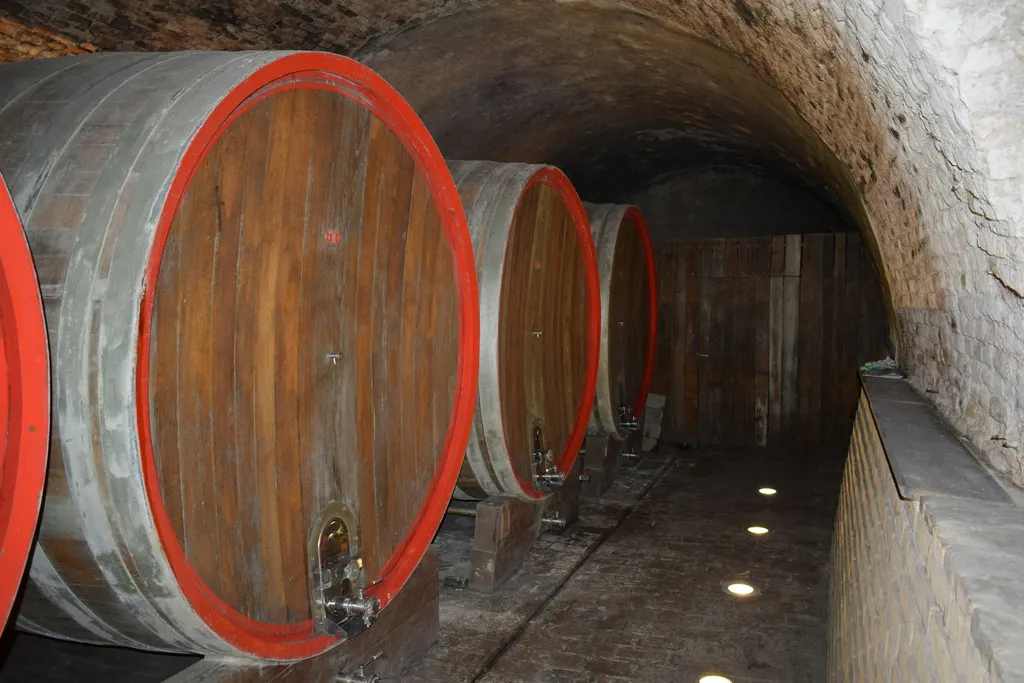
A cellar of barrels is not a uniform batch. Each barrel has its own age, origin and toast, and gives the wine inside it a slightly different measure of oxygen and flavour — which is why knowing what is in each one matters.
French oak or American oak?
Not all oak is the same, and the two most common sources give noticeably different results.
French oak (mostly Quercus petraea and Quercus robur) has a tight grain and gives more restrained, subtle flavour — fine spice, cedar, a savoury structure. It tends to support a wine rather than announce itself, which is why it is the classic choice for wines built around finesse and for grapes like Pinot Noir and Chardonnay. Because the tight grain forces coopers to split the wood by hand and season it for years, French oak is also more expensive to make — a cost that follows it into the cellar.
American oak (Quercus alba) has a looser grain and, importantly, several times more oak lactone than French oak. The result is bolder and sweeter: pronounced vanilla and coconut, a more openly wood-driven flavour. Its straighter grain can be sawn rather than split, which makes it cheaper to produce. It has long been associated with styles that welcome that generosity, from traditional Rioja to many New World reds.
Neither is superior — they are different instruments. A winemaker chooses to match the grape and the intended style, and plenty of cellars blend barrels of both, folding the two together to take a measure of each.
| Oak source | Grain and lactone | Typical character | Often used for |
|---|---|---|---|
| French (Q. petraea / robur) | Tight grain, lower lactone | Fine spice, cedar, restrained structure | Pinot Noir, Chardonnay, finesse-driven reds |
| American (Q. alba) | Looser grain, high lactone | Bold vanilla, coconut, sweet wood | Rioja-style reds, generous New World reds |
| A blend of both | Mixed | A measured part of each character | Wines wanting body without a single loud signature |
Origin is only the starting point. Two French barrels from different forests — or the same forest, seasoned differently — will not behave identically, which is one more reason a cellar treats barrels as individuals rather than interchangeable units.
What barrel toast levels do
Before a barrel ever holds wine, the cooper shapes and bends the staves over an open fire, and that same fire is used to toast the inside of the barrel to a chosen intensity. Toast is not an afterthought — it is one of the biggest levers on the final flavour, because heat transforms the wood’s compounds.
- Light toast keeps more of the raw-wood and fresh-spice character, with brighter, firmer tannin and less sweetness. It lets the oak’s structure show through.
- Medium toast is the common all-rounder: heat has developed vanillin and caramel notes and a rounded warmth, without pushing into smoke. Much commercial barrel aging lives here.
- Heavy toast drives the wood toward smoke, roasted coffee, dark spice and a char-like edge, while muting the oak’s own sweet lactone character.
Choosing a toast level is choosing part of the wine’s flavour signature before a single drop goes in, which is why a serious barrel order specifies origin, format and toast together. And it is one more axis of variation on the cellar floor: a rack of medium-toast French barriques and a rack of heavy-toast American puncheons are doing genuinely different work, even filled with the same wine.
New barrels, neutral barrels, and everything between
A barrel is not a fixed thing — it fades with use, and that fade is a feature, not a defect.
A new barrel gives the most of everything: the strongest oak flavour and the most oxygen. It also makes the loudest statement, and a wine over-exposed to new oak can end up tasting more of the barrel than of itself. With every vintage a barrel gives a little less, as the accessible flavour compounds are drawn out and the wood settles. After roughly three or four years, a barrel is considered neutral: it still offers gentle micro-oxygenation, but very little oak flavour.
This is why neutral barrels are valuable in their own right. They let a winemaker give a wine the softening, texturising benefit of barrel aging without overtly oaking it — ideal for wines where you want roundness but not vanilla and toast.
The real craft is in the mix. Rather than aging a wine in all-new oak, a winemaker typically blends new, one-year, two-year and neutral barrels in chosen proportions, then adjusts the ratio vintage to vintage to hit the oak level the style calls for. “20% new oak” is a recipe, and it only means anything if you know which barrels are which. Get that percentage wrong because two barrels were mislabelled and the wine drifts off style — not dramatically, but enough that a careful drinker notices the vintage is not quite the one before.
Barrel formats and oxygen exposure
Barrels come in sizes, and size matters because it changes the ratio of wood surface to wine. More surface per litre means faster oaking and more oxygen; less surface means a gentler, slower influence.
The classic small barrel is the barrique, holding around 225 litres (Bordeaux) — the Burgundian pièce is a close 228. Its small volume means a lot of wood contact per litre, so it oaks and oxygenates relatively quickly and strongly. Larger formats like the puncheon (commonly around 500 litres) have proportionally less wood contact per litre, giving a gentler, slower influence — useful when you want the breathing benefit of oak without a heavy flavour signature. Big old foudres, holding thousands of litres, take this furthest: almost pure slow oxygenation with minimal wood flavour.
| Format | Approx. volume | Wood contact per litre | Oxygen and oak intensity |
|---|---|---|---|
| Barrique / pièce | 225–228 L | High | Fast, pronounced |
| Puncheon | ~500 L | Moderate | Gentler, slower |
| Foudre (large cask) | Several thousand L | Low | Mostly slow oxygenation, little oak flavour |
Choosing a format is, in part, choosing how intense the oak effect will be — and how quickly it arrives. A wine that would be swamped by new barriques in six months can sit contentedly in a puncheon for a year and come out balanced. This is the same logic that governs fermentation temperature: you are managing the rate of a transformation, not just whether it happens.
The angels’ share and the endless topping round
There is a loss the cellar cannot avoid: the angels’ share. Because the staves are porous, wine evaporates through them steadily as it ages — commonly around 2–5% of the barrel’s volume per year, depending on the cellar’s humidity and temperature and the barrel’s size. A cellar kept humid loses more water and less alcohol; a dry cellar loses the reverse. Either way the level in the barrel falls, and as the headspace grows the wine is exposed to more air than intended.
The remedy is topping up: refilling each barrel with more of the same wine to keep it full and protected. This is not optional and it is not occasional — it is a recurring round through the whole cellar, because oxygen collecting in a barrel’s headspace can quickly turn a slow, beneficial exposure into spoilage. Topping works hand in hand with the wine’s sulfite protection: a full barrel and a sound free-SO₂ level are two halves of the same defence against oxidation.
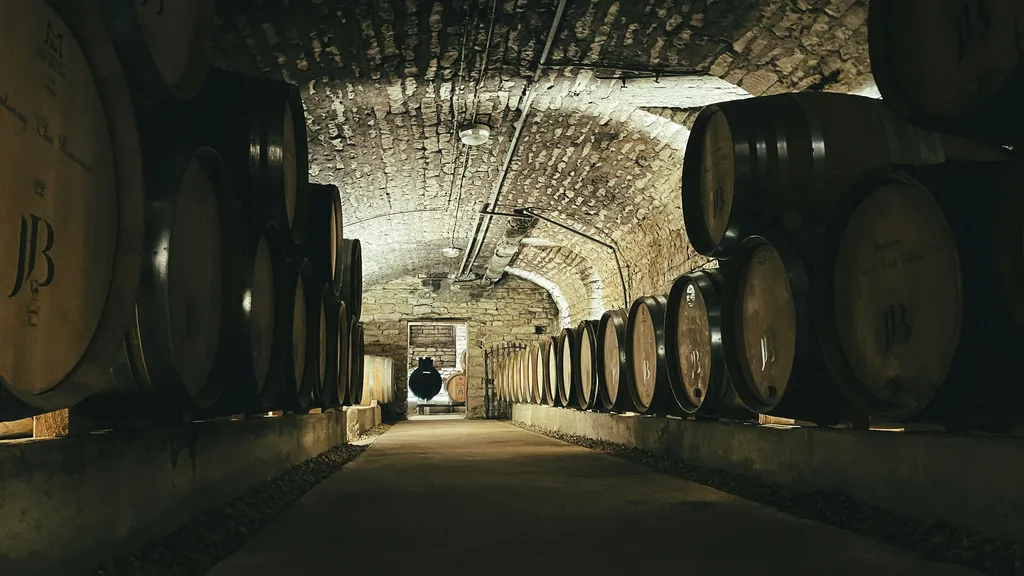
Topping is unglamorous, routine, and essential. It also means a barrel program constantly consumes a little of its own wine — a real loss that has to be planned for and accounted for, not treated as a rounding error. Over a year a cellar of a few hundred barrels quietly gives up the equivalent of several full barrels to the angels, and every top-up draws that make-up wine from somewhere. If the paper trail does not follow those movements, the cellar’s records and its actual stock drift apart until an inventory count comes as an unpleasant surprise.
Keeping the wood clean
A barrel is a living, porous container, and that is exactly what makes hygiene non-negotiable. The same pores that let oxygen in can harbour spoilage organisms — Brettanomyces yeast being the classic barrel-borne fault, capable of turning a wine sharply toward barnyard and medicinal notes. Once Brett is established deep in the wood, a barrel is very hard to rescue.
So barrels are cleaned between fills — rinsed, sometimes steamed or treated — and kept under the right conditions when empty, so they neither dry out and leak nor grow mould. An empty barrel is not idle inventory; it is an asset with a condition and a history that determine whether it is safe to fill again. Knowing when a given barrel was last cleaned, and what it last held, is part of protecting the next wine that goes into it.
The economics of a barrel program
Barrels are one of a cellar’s larger recurring costs, and thinking of them as equipment rather than consumables leads to bad decisions. A new French barrique is a meaningful capital outlay, and its most valuable, most flavour-active life is short — that intense first fill, then a diminishing return over the next few years. Spread the purchase price across the wine that passes through the barrel while it is genuinely new, and the per-bottle cost of “new French oak” is real money.
That is why the new-to-neutral progression is an economic strategy as much as a stylistic one. A barrel bought new for a flagship red earns its keep in year one, then does honourable work as a one-year and two-year barrel on other wines, and finally serves for years as a neutral vessel for gentle oxygenation. Getting the full value out of a barrel means knowing, for each one, how old it is, how many wines it has seen, and what it is fit for next — the difference between a fleet managed on purpose and a pile of barrels of unknown provenance. Add the angels’ share on top, and a barrel program has two continuous costs running in the background: the slow depreciation of the wood and the steady evaporation of the wine.
Why barrel tracking decides consistency
Put all of this together and a truth emerges: a barrel cellar is not one batch, it is dozens of slightly different ones. Every barrel has its own oak origin and toast, its own age, its own fill date, its own slow evaporation, its own cleaning history. The wine in a new French barrique is on a different trajectory from the same wine in a three-year-old puncheon two rows over.
That is what makes barrel tracking a winemaking discipline, not administrative overhead. To blend consistently — to reproduce “20% new French oak, 14 months” next year — you have to know, for each barrel, what it holds, its origin, toast and age, when it was filled, and when it was last topped. Lose that thread and your “barrel-aged” wine becomes a lottery of whichever barrels happened to be in the blend. This is the same discipline that separates a real cellar ledger from a spreadsheet: a record that follows each vessel through every action, rather than a snapshot that is already out of date.
This is where a system that treats each vessel as a real, individually recorded object pays off. In Wineopsys, a barrel is a vessel with its own history: the wine in it, its fill and topping rounds, the actions performed on it, and its place in the finished blend are all recorded per barrel rather than as a single undifferentiated pool. The awkward part of cellar work — that a topping round touches forty barrels in one pass — is handled as a multi-vessel round: one pass across the cellar writes forty individual per-vessel records, and a barrel deliberately skipped is recorded as a fact, not a silent gap. You get the speed of working the whole rack at once and the precision of a separate record for every barrel.
Because those records are the same ledger that projects stock, the angels’ share stops being invisible. Evaporation and topping losses are captured as the wine level moves, so the volume the system shows for a barrel reflects what is actually in it, not what was put in months ago. And when a cellar hand notices a barrel drifting — a level falling faster than its neighbours, a smell that says clean me — the team messenger can reference the exact vessel and lot, so the conversation and the record point at the same barrel. When you can see every barrel distinctly, “our oak program” stops being folklore and becomes something you can actually repeat.
The bottom line
Oak is not magic and it is not decoration. A barrel gives wine concrete things — a slow trickle of oxygen, a palette of flavour compounds, a little structure — and every choice around it (French or American, light or heavy toast, new or neutral, barrique or puncheon) is a way of tuning how much of each the wine receives. The angels’ share quietly takes its cut the whole time, so topping and hygiene never stop, and the wood itself depreciates from the first fill. Do all of it well and consistently, and you have a signature. Do it without knowing what is in each barrel, and you have a different wine every vintage — which is why, in the end, barrel aging rewards the winemaker who keeps track as much as the one with the best oak.
Wineopsys is being built to make that record-keeping the natural by-product of cellar work rather than a second job after it — per-barrel history, multi-vessel rounds, and stock that accounts for what the angels take. If that is the kind of cellar you are trying to run, you are welcome to join the waitlist and follow along as it takes shape.
Frequently asked questions
- What does an oak barrel do to wine?
- An oak barrel changes wine two ways at once. First, its porous wood lets a tiny, steady trickle of oxygen reach the wine — micro-oxygenation — which softens tannins and stabilises colour over months. Second, the wood itself gives up flavour compounds: vanillin for vanilla notes, oak lactones for coconut and sweet wood, and toast-derived compounds for spice, smoke and clove. The barrel is therefore both a slow oxygen source and a flavour ingredient, which is why oak-aged wine tastes rounder and more complex than the same wine kept in inert steel.
- What is the difference between French and American oak?
- French oak (Quercus petraea and robur) has a tighter grain and gives subtler, more restrained flavour — fine spice, cedar and a gentle structure — which is why it is favoured for wines meant to show finesse. American oak (Quercus alba) has several times more oak lactones and gives bolder, sweeter notes of vanilla and coconut, with a more openly wood-driven character. Neither is better; they are different tools. Many wineries choose one to match the grape and style, and some blend barrels of both to get part of each.
- How long is wine aged in oak barrels?
- It depends on the style and the wine's structure. Light, fruit-forward reds and many whites may see only a few months of oak, while structured reds built for the long haul commonly age twelve to twenty-four months before bottling, and some spend longer still. The barrel's age matters as much as the clock: a new barrel needs less time to make its mark, while a neutral barrel can hold wine for many months mostly for gentle oxygenation. There is no single correct duration — only the length that suits the wine and the intended style.
- What are barrel toast levels?
- Toast is the controlled charring the cooper applies to the inside of a barrel over a fire, and its intensity shapes flavour. A light toast keeps more raw-wood and fresh spice character with brighter tannin; a medium toast — the common all-rounder — brings vanilla, caramel and a rounded warmth; a heavy toast pushes toward smoke, roasted coffee and dark spice while muting the wood's own sweetness. Choosing a toast level is choosing part of the wine's flavour signature before a drop ever goes in.
- What is the angels' share?
- The angels' share is the wine lost to evaporation through the porous walls of the barrel as it ages — commonly around 2–5% of the barrel's volume per year, depending on cellar humidity, temperature and barrel size. Because the wine level drops and air fills the gap, barrels must be regularly topped up with more of the same wine to keep them full and limit oxidation. Topping up is routine cellar work, and the evaporation it compensates for is a real, ongoing loss that a winery has to account for.
- Do you have to use new barrels?
- No, and most wine is not aged in all-new oak. A new barrel gives the strongest flavour and the most oxygen; with each vintage it gives less, until after roughly three or four years it becomes a 'neutral' barrel that contributes gentle oxygenation but little oak flavour. Neutral barrels are valuable in their own right for softening a wine without overtly oaking it. Winemakers deliberately blend new, one-year, two-year and neutral barrels to dial the level of oak influence up or down for the style they want.